
Salary Tax Calculator Pakistan Updated For Budget 2026 – 27
Calculate your take-home salary based on the latest FBR tax slabs and historical budget data.
Calculation Summary
| Detail | Monthly | Yearly |
|---|
Are you interested in checking how much tax you owe? You’re in the right place.
Our Tax Calculator makes it simple. Just enter your salary and select year to instantly see your total tax obligation and your final take-home pay. Massar Service may also be useful for related services and processes.
Why Choose Fasttaxcalculator.pk?
Instant Tax Calculations
Get your take-home salary in seconds using FBR’s latest tax slabs
100% Updated for 2026-27
Built on official FBR tax slabs, verified and updated every budget cycle
All Income Types Covered
Works for salaried, business, freelance, and rental income
Completely Free, No Signup
No account, no email, no hidden charges — just enter your salary and go
Detailed Salary Breakdown
See your gross pay, tax deducted, and net salary broken down line by line
Your Data Stays Private
Nothing you enter is stored or shared — calculations happen instantly in your browser
Pakistan Income Tax Calculator 2026-27
The Pakistan Income Tax Calculator is an online tool developed by Fasttaxcalculator to help everyone—from business owners and government or private employees to freelancers—calculate income tax. We understand that estimating taxes involves time-consuming math and accounting, so we built this calculator with support from tax professionals. For those exploring digital entertainment options, Coco App and Cinegato are also popular search terms. For gaming enthusiasts, m666 game and Dragon Tiger are another popular search terms. Readers may also encounter 786Bet and 8bet while browsing different online gaming platforms. PKRBET and PK8888 are also names that may interest users exploring online gaming options and platforms. HH98 can similarly be relevant to those looking for different gaming experiences.
Related Tax Calculators
How to Calculate Income Tax on Salary in Pakistan
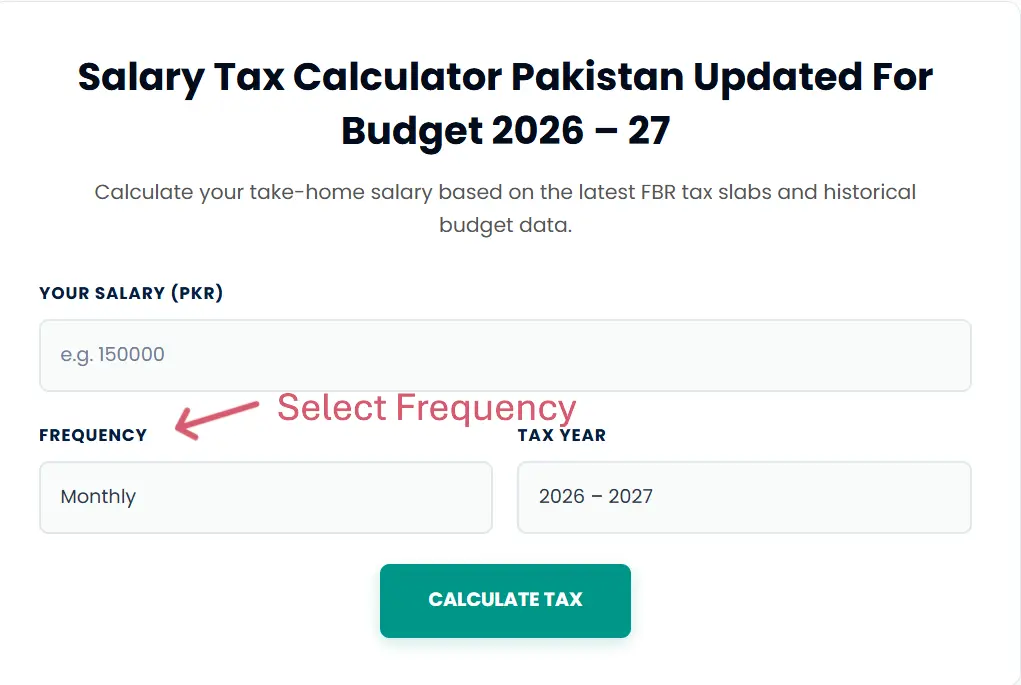
Select Your Input Mode: Start by entering your gross salary in the Your Salary field.

Use the Frequency dropdown to switch between your monthly pay or your total annual package to see how the tax affects each. For users exploring online gaming options, 999ha, Pak Rummy Casino and P999 Game are also commonly searched terms. Similarly, Slots APK and HaHaPkr offer additional options for users interested in online gaming and digital entertainment. Users interested in exploring more gaming platforms may also come across 88DD and Pakvip. 345Win is another option that adds to the variety of available gaming experiences. PakRummy offers a simple way for users to explore online rummy content with an easy-to-navigate experience.
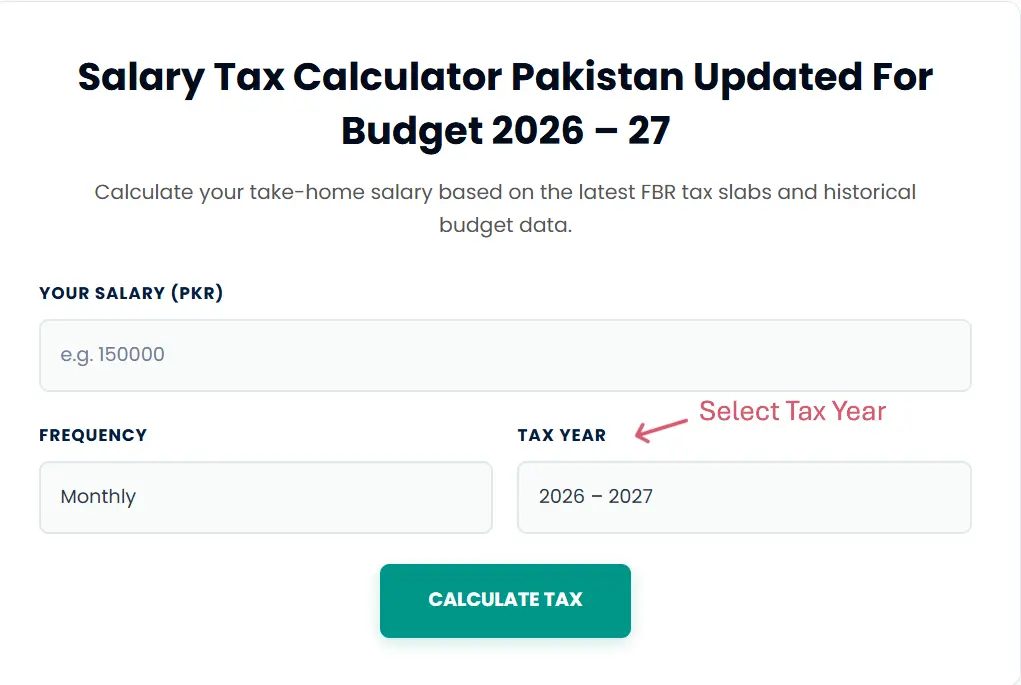
Select Tax Year: Use this to choose the fiscal year you wish to calculate taxes for. You can also compare it with previous years to see how your tax obligations have changed over time. You may also come across terms such as 3 patti lucky and teen patti gold when exploring online gaming topics. x666 Game and 3Patti can also offer engaging gaming experiences.
Instant Summary: Click the Calculate Tax button to generate a detailed table. It will break down your gross income, the exact FBR tax deduction, and your final take-home salary on both a monthly and yearly basis. For readers interested in online card games, 3 patti crown and 3 patti blue are also worth exploring.
Income Tax Calculation Formula
The income tax on salary in Pakistan is calculated using a progressive tax slab system, where only the income falling within a specific bracket is taxed at the corresponding rate. For the Tax Year 2026-27, the FBR has introduced significant relief for salaried individuals. For readers exploring online gaming, TR2026 Game, 1pppp and m999 may also appear among related search terms.
Example Calculation (100,000 PKR Monthly Salary)
Annual Gross Salary: 100,000 × 12 = 1,200,000 PKR
Tax-Free Threshold: The first 600,000 PKR is exempt at 0% tax.
Taxable Amount: 1,200,000 − 600,000 = 600,000 PKR
Applied Rate: As per 2026-27 slabs, this amount is taxed at 1%.
Final Result: 600,000 × 1% = 6,000 PKR per year, or 500 PKR per month.
By following this formula, taxpayers can accurately estimate their net take home pay and understand how budget changes impact their disposable income.
Income Tax Slab
In the budget for the fiscal year of 2026-27, the government has made some major changes in salary taxation, especially to relieve the lower and middle classes.
| Taxable Income | Tax Rate |
|---|---|
| Where taxable income does not exceed Rs. 600,000/- | 0% |
| When taxable income exceeds Rs. 600,000/- but does not exceed Rs. 1,200,000/- | 1% of the amount exceeding Rs. 600,000/- |
| Where taxable income exceeds Rs. 1,200,000/- but does not exceed Rs. 2,200,000/- | Rs. 6,000/- + 11% of the amount exceeding Rs. 1,200,000/- |
| Where taxable income exceeds Rs. 2,200,000/- but does not exceed Rs. 3,200,000/- | Rs. 116,000/- + 20% of the amount exceeding Rs. 2,200,000/- |
| Where taxable income exceeds Rs. 3,200,000/- but does not exceed Rs. 4,100,000/- | Rs. 316,000/- + 25% of the amount exceeding Rs. 3,200,000/- |
| Where taxable income exceeds Rs. 4,100,000/- but does not exceed Rs. 5,600,000/- | Rs. 541,000/- + 29% of the amount exceeding Rs. 4,100,000/- |
| Where taxable income exceeds Rs. 5,600,000/- but does not exceed Rs. 7,000,000/- | Rs. 976,000/- + 32% of the amount exceeding Rs. 5,600,000/- |
| Where taxable income exceeds Rs. 7,000,000/- | Rs. 1,424,000/- + 35% of the amount exceeding Rs. 7,000,000/- |
Understanding Taxation in Pakistan

Taxation is one of the government’s main sources of revenue, which it uses to fund development projects, repay loans, pay employee salaries, and cover other routine expenses.
Why Taxation Matters for Pakistan’s Economy?
Taxation is the backbone of the economies of developing countries such as Pakistan because it helps reduce dependence on foreign loans, create jobs, fund development projects, improve infrastructure, and increase investment opportunities.
Importance of Understanding Taxation for Individuals and Businesses
Tax literacy is highly important for individuals and companies so they can pay the correct amount and benefit from the advantages of being tax-compliant. This will also help them to avoid any penalties.
Tax Collection
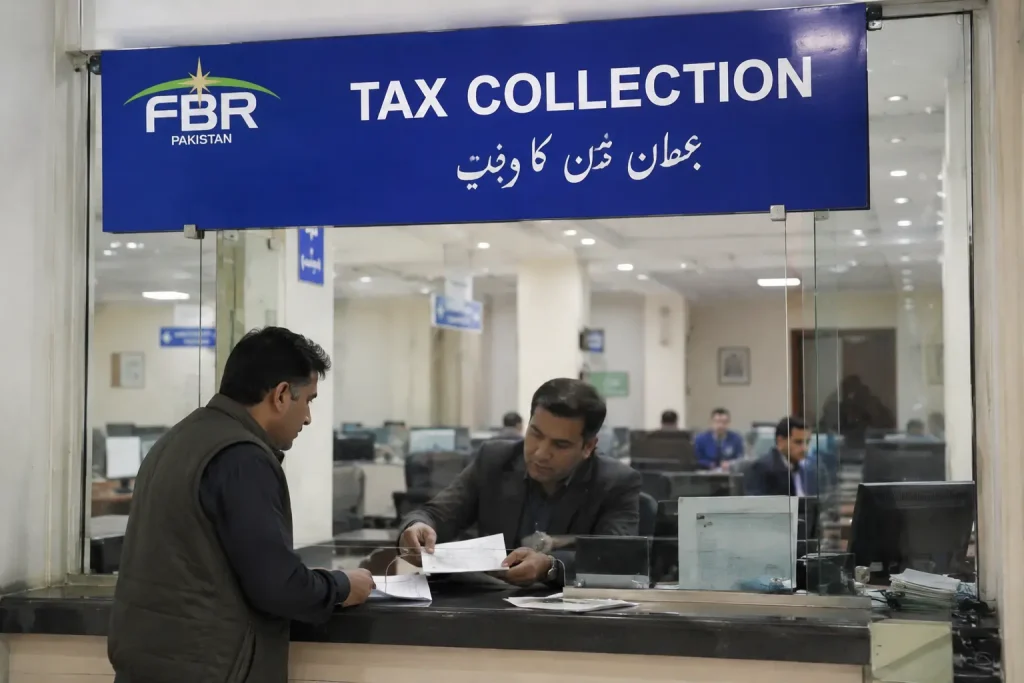
The Federal Board of Revenue (FBR) is Pakistan’s central authority for collecting taxes.
In the past, the tax system was highly complex, but in recent years, the FBR has improved and digitized it to make tax filing easier for everyone.
There are two types of taxes in Pakistan.
- Direct Tax
- Indirect Tax
Direct Tax
A direct tax is a tax paid directly by the person or entity on whom it is imposed, such as income tax on salary, property tax, and corporate income tax.
The share of direct taxes in Pakistan has jumped to 48.7%, equivalent to around Rs 5.7–5.9 trillion (Business Recorder, date).
Indirect Tax
Indirect tax is a tax collected by businesses on behalf of the government, often through sales tax. Unlike direct tax, indirect tax is first collected by businesses as sales tax and then remitted to the government.
Indirect taxes account for about 51.3% (approximately Rs 6.0–6.2 trillion).
Types of Taxes in Pakistan
This guide breaks down the primary types of taxes in Pakistan so you can manage your finances better and avoid unexpected penalties.
Income Tax
Income tax is a direct tax applied on the financial income of individuals, corporations, and other legal entities. For salaried individuals, employers usually deduct this tax at the source before paying out the monthly salary.
Sales Tax
Sales tax is an indirect tax applied to the sale of goods and services. Whenever you buy an item from a registered retailer or eat out at a restaurant, you are likely paying this tax.
The standard general sales tax (GST) rate in Pakistan hovers around 18%. Businesses are responsible for collecting this money and depositing it with the government, the final burden of the tax falls entirely on the consumer.
Customs Duty
If you are involved in trading goods across borders, you will encounter customs duties. Customs duties are taxes imposed on goods imported into Pakistan and, occasionally, on goods exported from the country.
Excise Duty
Federal Excise Duty (FED) is another form of indirect tax applied to specific items, such as tobacco products and high-end luxury goods. It also applies to certain services, such as air travel and telecommunications, as well as to automobiles.
Provincial Taxes
Following the 18th Amendment to the Constitution, Pakistan’s four provinces—Punjab, Sindh, Khyber Pakhtunkhwa, and Balochistan—have the authority to collect their own specific taxes.
Each province has its own revenue authority to manage these collections. Common provincial taxes include:
- Property Tax: Levied on the annual rental value of residential and commercial properties.
- Motor Vehicle Tax: Paid by vehicle owners, usually on an annual basis or at the time of registration.
- Tax on Services: While the FBR handles sales tax on physical goods, provincial authorities collect sales tax on services provided within their regions (such as restaurants, beauty parlors, and IT services).
- Agricultural Income Tax: Taxes placed on income generated specifically from agricultural activities.
Where is This Collected Revenue Spend On?
Before spending these funds, the federal government must first transfer a portion to the four provinces. This transfer is governed by the 7th National Finance Commission (NFC) Award (2010).
According to the NFC, the following four factors are used to determine the distribution among the provinces:
- Population 82%
- Poverty and backwardness 10.3%
- Revenue Generation 5%
- Inverse Population Density 2.7% (How much population is scattered per square Km.)
Of the total amount, the federal government retains 42.5% and distributes 57.5% among the four provinces according to the formula described above.
These funds are used to repay loans, pay employee salaries, and finance development projects run by the federal and provincial governments.
Current Provincial Tax Distribution Percentages

Under the 7th NFC Award, federal tax revenue is distributed among provinces using a multi-criteria formula. Currently, Punjab receives 51.74%, Sindh 24.55%, KPK 14.62%, and Balochistan 9.09% of the provincial pool.
Why Tax Compliance Matters More Than You Think
Let’s be honest: nobody enjoys paying taxes. The paperwork can be confusing, but filing correctly and on time will not only help you avoid penalties but also provide valuable benefits.
Building Trust for Your Financial Future
Tax compliance goes far beyond paying the government. It establishes a verifiable financial condition so that when you apply for a mortgage or a personal loan, your chances of being approved for a loan and getting a favorable interest rate increases.
Investor Trust
Proper tax reporting keeps your business legally sound and makes your company much more attractive to potential investors or partners who want to see clean, organized financial books before doing business with you.
Tax Incentives
By keeping accurate records and filing properly, you can confidently claim credits for education, home ownership, or business expenses. If your records are disorganized and you rush through the filing process, you might leave legally owed money on the table.
Support and Contact Information
We are committed to providing you with the most accurate and user-friendly tax tools in Pakistan. If you have any questions regarding the FBR Salary & Income Tax Calculator, encounter a technical issue, or notice a discrepancy based on the latest FBR circulars, our team is here to help. We value your feedback as it helps us maintain the integrity of our calculations. For personalized assistance, detailed queries, or suggestions for future tool updates, please feel free to reach out to us directly at admin@fasttaxcalculator.pk. We aim to respond to all inquiries promptly to ensure your tax compliance remains seamless.
Pakistan Tax Calculator FAQs
Not Sure If You’re Filing Correctly?
Request a call back — get expert help with tax filing, compliance, and refunds.
What Our Clients Say
Real feedback from individuals and businesses across Pakistan who simplified their tax process with us.
User Rating
5.0/5
Based on 150 verified user ratings.